Third Sunday after Epiphany 2025
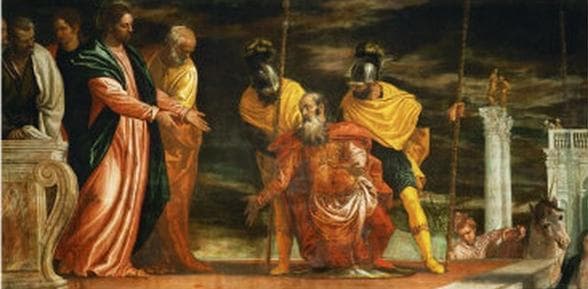
In the Gospel, we encounter the story behind the prayer we say at Mass just before Communion, ‘Domine, non sum dignus.’ The centurion seeks healing for his servant, but believes that the Lord can heal from afar, and that he is not worthy of a visit. Because of the greatness of his faith, Christ heals his servant at a distance.
Dearly beloved,
Today we mark the third Sunday after Epiphany. In the Gospel, we encounter the story behind the prayer we say at Mass just before Communion, ‘Domine, non sum dignus.’ The centurion seeks healing for his servant, but believes that the Lord can heal from afar, and that he is not worthy of a visit. Because of the greatness of his faith, Christ heals his servant at a distance.
The use of this story as a prelude to the reception of Communion is common to both East and West. Some eastern liturgical traditions incorporate the centurion’s words into a longer prayer confessing sinfulness. For example, the Ethiopians say, ‘O Lord, Lord, it is in nowise fitting for thee to come under the roof of my polluted house, for I have provoked thee and stirred thee to anger and have done evil in thy sight and have polluted my soul and my body…but for the sake of thy being made and thy becoming man for my salvation…I pray thee and beseech thee that thou wouldst purge me from all guilt and curse and sin…’
In the Roman rite, the Domine non sum dignus is found as early as the late 900s. As is often the case, our use of it is not as florid or expressive as in the eastern liturgies, but it does suppose knowledge of the background and an application to our own state. We are at once the centurion and the servant, having faith in Christ but also in need of profound healing. By the terse Roman prayer, we are in effect saying, ‘Lord I am not worthy, but you must say a word of power so that I will be cleansed of whatever offends you. I am like a sick man, but I need your presence in my soul, so please absolve me. I need communion with you, or else I will die.’
The context of the Domine non sum dignus should cause us to reflect on two things. First, tradition speaks of the soul as being a house, a house where God wishes to dwell. As is the case with a house in winter, we want our house to be warm, burning with the fire of charity. To have a warm house, of course, we must close the windows and not let in cold air from the outside. This represents the need to be vigilant about our senses and our contact with the world. Each one of us must take in things from our environment, for human beings learn through the senses. But most of us choose to let in certain things that have limited value for the spiritual life, and may even be detrimental. The senses are like windows in a house—if we leave them open all the time, we let in outside air. That might be alright in the spring, summer, or fall, but not in winter. And this world is growing colder by the day, cold towards God and man alike. So we should open the windows wisely, letting in things that will help our prayer rather than hinder it; things that will move us to greater fervor, rather than make us lethargic.
This includes everyday things like music, news, food, drink, images. If God comes to be our guest, evidently we should not have someone or something in the house which he detests. But we also know that even good sensory inputs stay with us longer than we would like. If one listens to radio, days later he finds some vocalist singing upstairs in his house while he tries to pray. Or someone may watch a film, and the next day come across the lead actor or actress sitting by the hearth fire, drinking hot chocolate, when he wanted to be alone with God. The music and the film are not wrong per se, but we want the Lord to feel welcome in our soul and not uncomfortable; and there is hardly anything more uncomfortable than finding a strange person wandering through one’s house. So be mindful of how you use your senses and what you take in; choose carefully and with a mind for guarding your recollection and fervor.
Second, we should take note of why it is that Christ grants the centurion’s petition. He says: ‘Go, and as thou hast believed, so be it done to thee.’ The centurion believed that Christ was God, and so his faith was the instrumental cause of the servant’s healing—God used his belief to heal. In the prayer we recite at Mass, we are not refusing the Lord entry into our house; we are rather asking him to purify us before he comes. And just as the servant’s healing depended upon the faith of the centurion and his desire for the well-being of his servant, so the healing of our soul before Communion depends very much upon our faith in Christ’s power to heal us and our desire to be healed. We can easily err on either side: perhaps we have struggled with something for so long that we no longer have confidence Jesus can heal us; if so, we should ask the leper of today to pray for us that we might have his confidence in addressing Christ. In fact, in one medieval Austrian missal, his prayer is combined with the centurion’s: ‘Lord, I am not worthy that thou shouldst enter under my roof, but if thou wilt, thou canst make me clean.’
The other possibility is that we don’t think we need much healing, and consequently, we have little desire for it. Perhaps after confession or after a stretch of a good day or two we have become blind to our constant need for divine grace. In this case, we should pray to the saints who were notorious sinners, like St. Mary Magdalene or St. Augustine, that we would truly know our sins and earnestly desire repentance, even to the point of tears.
We don’t know how long the centurion’s servant had been sick; it might have been for some time. But his master sensed the urgency and the opportunity. With the Son of God come down upon the altar, for us the time is now to beg for healing. So let us not waste it through pride or distraction, but seize the moment each time we attend Mass, saying the prayer with feeling and growing fervor a second, and then a third time. And then may we merit to sense deeply in our souls the divine response: ‘as thou hast believed, so be it done to thee. I will it; be thou made clean.’